
A recent study found people with higher religiosity (strong religious feelings or beliefs) are more trusting of things they can’t see, which leads to greater trust in and positive evaluations of companies using artificial intelligence.
While prior research has found that higher religiosity consumers are often resistant to change and hesitant to adopt new technology, the present research found the opposite to be true.
“Consumers with higher levels of religiosity have higher levels of trust in the unseen, given that they have to trust a supernatural being that they do not physically get to interact with on Earth,” says the study’s lead author Elizabeth Minton, a professor in the College of Business at the University of Wyoming. “This may help to explain why religiosity is positively associated with AI perceptions, such that higher religiosity consumers are more trusting in unseen things (particularly in a god or divine being), which enables them to also trust in other unseen things, such as AI.”
The use of AI by businesses (think chatbots, personalized marketing, and AI store robots) has exploded in recent years. Given the increase, it’s important to better understand the psychological determinants to acceptance of AI. “If companies want to effectively increase adoption and use of AI, then they should understand the influence of religion on AI response,” says Minton.
Three studies confirm findings
The findings were drawn from three studies that surveyed three groups of online participants. The questionnaire used in Study 1 asked 171 adults about trust in AI and then asked questions concerning religious beliefs. While the research team initially hypothesized that highly religious participants would have negative attitudes toward AI technology, they found the opposite to be true. Participants who self-reported as highly religious reported high levels of trust in artificial intelligence which influenced attitudes toward AI as well.
Study 2 “primed” religiosity in the online questionnaire, meaning that some participants were asked to write about their religious values before answering questions about AI. After the priming, the 192 adult participants were exposed to a visual of an AI restaurant server and answered questions assessing the restaurant and server. The results revealed that participants primed with religiosity reported higher attitudes toward the restaurant and the robot server.
In Study 3, researchers examined AI in another context that is used by many online companies: virtual conversational agents (chatbots). Participants were randomly assigned to view one of the three images below and answer questions regarding attitudes toward the company, trust in the company, trust in the unseen, and religiosity.
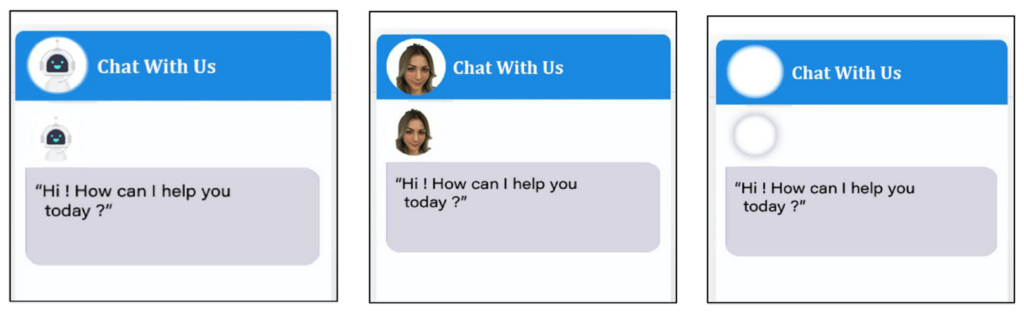
Participants with high levels of religiosity had little problem interacting with the three virtual assistants, rating the company highly no matter which bot they saw on their screen. However, those with low religiosity had lower opinions of the company using the chatbots. Says Minton, “This study’s findings…(are) continuing to confirm the effects found in Studies 1 and 2. Our findings provide support for the influence or religiosity on AI evaluations in yet another context as well—with a virtual conversation agent.”
Minton’s team acknowledges that future research should be done, possibly using company data to confirm the significance of religiosity among customers. Yet the practical implications of the research are significant for companies in general and marketing teams in particular. “Marketers could use religiosity as a segmentation variable by which to target consumers first when introducing AI services or products,” says Minton. Further, marketers could use religious language in communications that promote new AI technologies (e.g., integrate the words miracle, belief, or tradition). The study paves the way for researchers and companies to continue to understand consumer attitudes as the adoption of AI grows.
Header image: “Woman Holding Hands with Robot” generated by Jen Gilbart on May 26, 2024 using Canva’s Magic Media tool.